Selecting a reliable forex signal provider is essential for traders aiming to maximize profits while minimizing risk. One of the most critical aspects of this selection process is understanding signal accuracy. Accurate signals provide higher probabilities of successful trades, helping traders make informed decisions. However, assessing accuracy requires more than just looking at win rates. Using the right metrics ensures a thorough and unbiased comparison between providers.
Why Signal Accuracy Matters
Signal accuracy directly impacts trading outcomes. An accurate signal helps traders identify profitable entry and exit points while maintaining disciplined risk management. Conversely, inaccurate or inconsistent signals can lead to losses, erode capital, and undermine confidence. Evaluating accuracy with measurable metrics ensures that traders choose providers capable of delivering reliable and actionable insights.
Key Metrics to Compare Signal Accuracy
- Win Rate
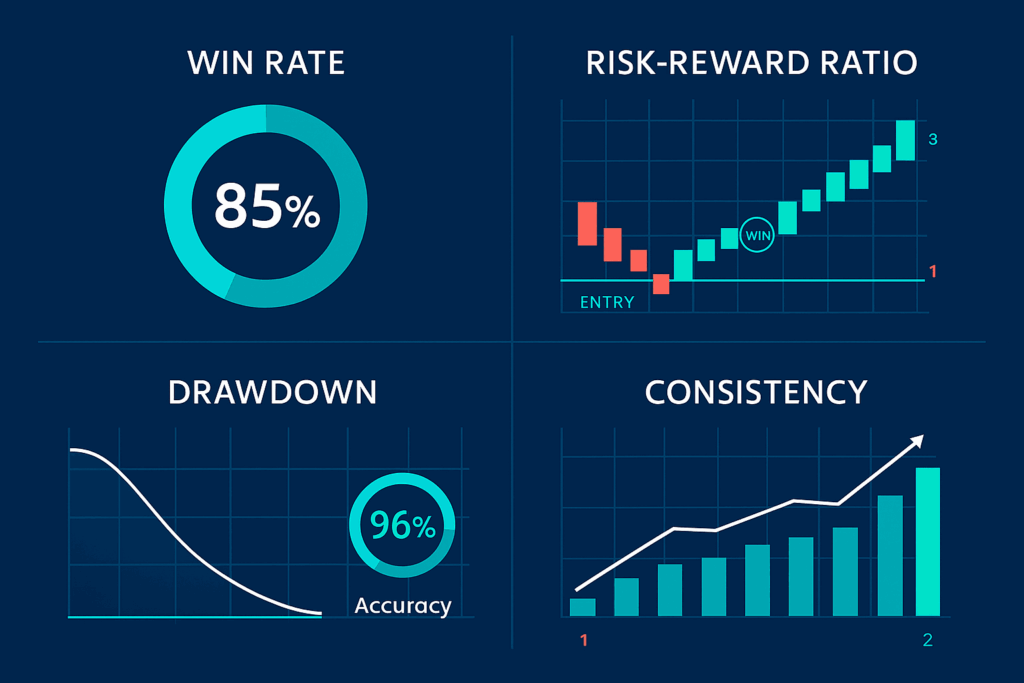
The win rate indicates the percentage of successful trades generated by a signal provider. While a higher win rate is generally desirable, it should be considered alongside risk-reward ratios. A signal with an 80% win rate but poor risk management may still result in losses. - Risk-Reward Ratio
This metric compares the potential profit of a trade against its potential loss. Providers recommending signals with a favorable risk-reward ratio, such as 1:2 or higher, can help traders achieve profitability even if the win rate is moderate. Evaluating risk-reward ensures that accuracy is considered in the context of overall trade quality. - Drawdown
Drawdown measures the decline in account equity from a peak to a trough during trading. A provider with frequent signals that cause significant drawdowns may be less reliable, even if the win rate appears high. Low and controlled drawdowns are indicators of signal consistency and risk management quality. - Consistency Over Time
Short-term spikes in accuracy may be misleading. It is crucial to evaluate signals over several months to ensure that performance is stable and not a result of random favorable trades. Consistency reduces the risk of sudden losses and improves trader confidence. - Accuracy by Market Conditions
Signals should be evaluated across different market environments, including trending, ranging, and volatile conditions. Providers able to maintain accuracy in diverse conditions demonstrate robust methodologies and adaptability. - Response Time and Execution Reliability
Timely delivery of signals is critical. Metrics like average delay in signal delivery and execution reliability ensure that trades can be entered and exited at the optimal moment, preserving accuracy in real trading scenarios.
Step-by-Step Approach to Evaluating Providers
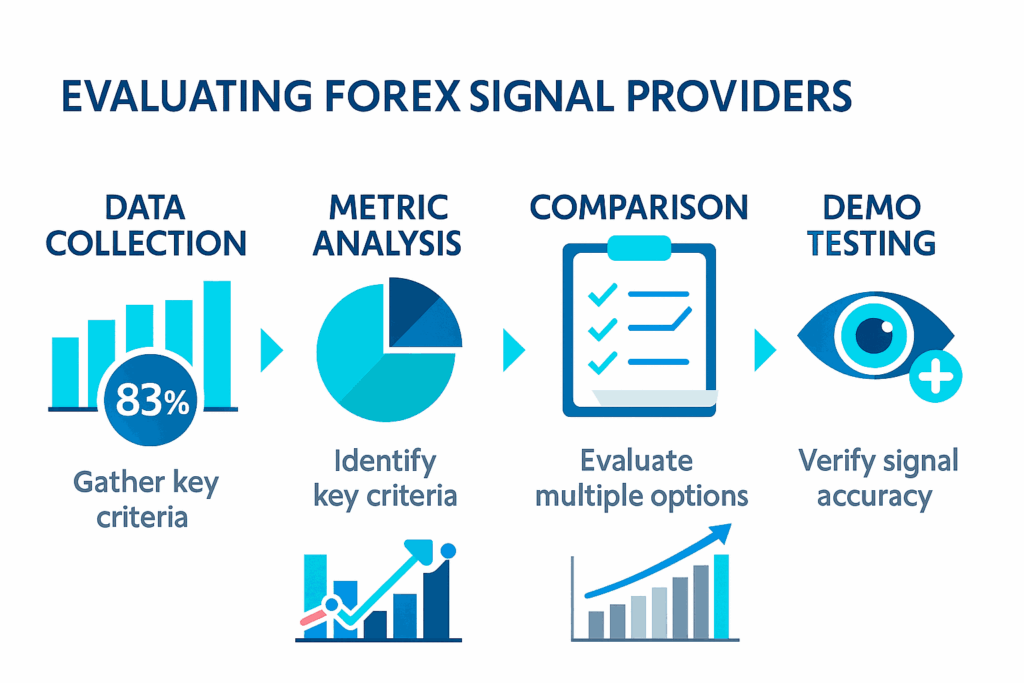
- Collect Historical Data – Obtain verified historical signal performance for at least six months to a year.
- Calculate Metrics – Assess win rate, risk-reward ratio, drawdowns, and consistency.
- Compare Across Providers – Use the same metrics for multiple providers to identify those offering the best overall performance.
- Test in a Demo Account – Apply signals in a controlled environment to see how metrics translate into real trading outcomes.
- Monitor Continuously – Regularly review performance metrics to ensure the provider maintains reliability over time.
Practical Example
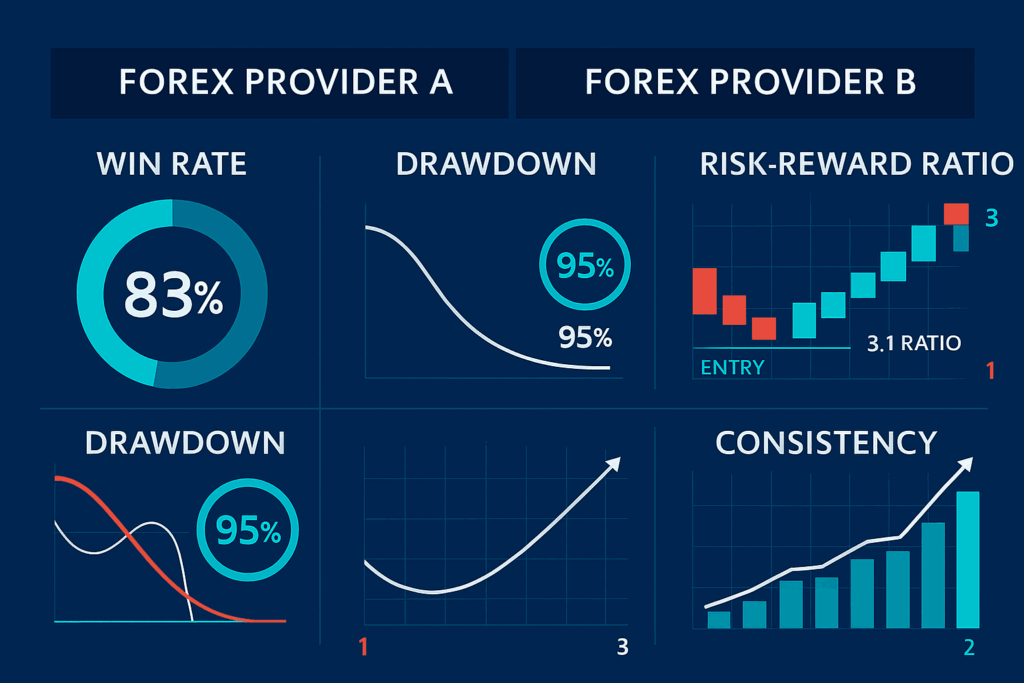
A trader comparing two providers notices that Provider A has a 75% win rate but frequent large drawdowns, while Provider B has a 68% win rate but a consistent 1:2 risk-reward ratio and controlled drawdowns. By focusing on comprehensive metrics rather than just the win rate, the trader chooses Provider B, which offers more sustainable profitability and reduced exposure to risk.
Conclusion
When comparing forex signal providers, relying solely on win rates can be misleading. Evaluating key metrics such as risk-reward ratio, drawdowns, consistency, and responsiveness provides a more accurate picture of a provider’s performance. By using these metrics systematically, traders can select signal providers that align with their strategy, enhance decision-making, and increase the likelihood of consistent trading success.